Pull up three different housing sites for Richmond Hill this month and you will get three different stories about the same town. One says prices jumped almost 10 percent in a year. Another says they slipped. A third says forget the percentage, here is what people actually paid at closing, and it is a number that does not match either of the first two.
If you are trying to decide whether now is the right time to sell a house here, or whether a listing price makes sense, that kind of contradiction is more than a curiosity. It changes what you do next. The good news is that the disagreement itself is useful. It tells you something the headline numbers can't: in a market moving this fast, the report you trust matters as much as the number in it.
Three Reports, Three Different Markets
Here is what was showing for Richmond Hill in the summer of 2026, side by side.
| Source | Window | What it's actually measuring | Richmond Hill reading |
|---|---|---|---|
| Redfin | Last month tracked (mid-2026) | Average house price, asking-influenced | Up 9.6% year over year, to roughly $400,000 |
| Zillow | Trailing 12 months | Home value index, a repeat-sales estimate | Down 1.8% year over year, to roughly $422,000 |
| Resideline | Six months ending August 2026 | Median of actual closing prices across 420 tracked sales | $446,895, with the middle half of sales between $383,940 and $555,900 |
None of these sources is wrong. They are measuring different things. Redfin's figure leans on recent asking and sale activity and moves fast, which is why a hot month of new-construction closings can push it up quickly. Zillow's index tries to estimate value across the whole housing stock, including homes that have not sold recently, which smooths out short-term swings and can lag behind what is actually happening in a fast-growing subdivision market. Resideline's number is the one closest to a straight answer to "what did people pay," but it only covers a six-month rolling window and it does not distinguish a 1970s ranch from a 2025 build on the same street.
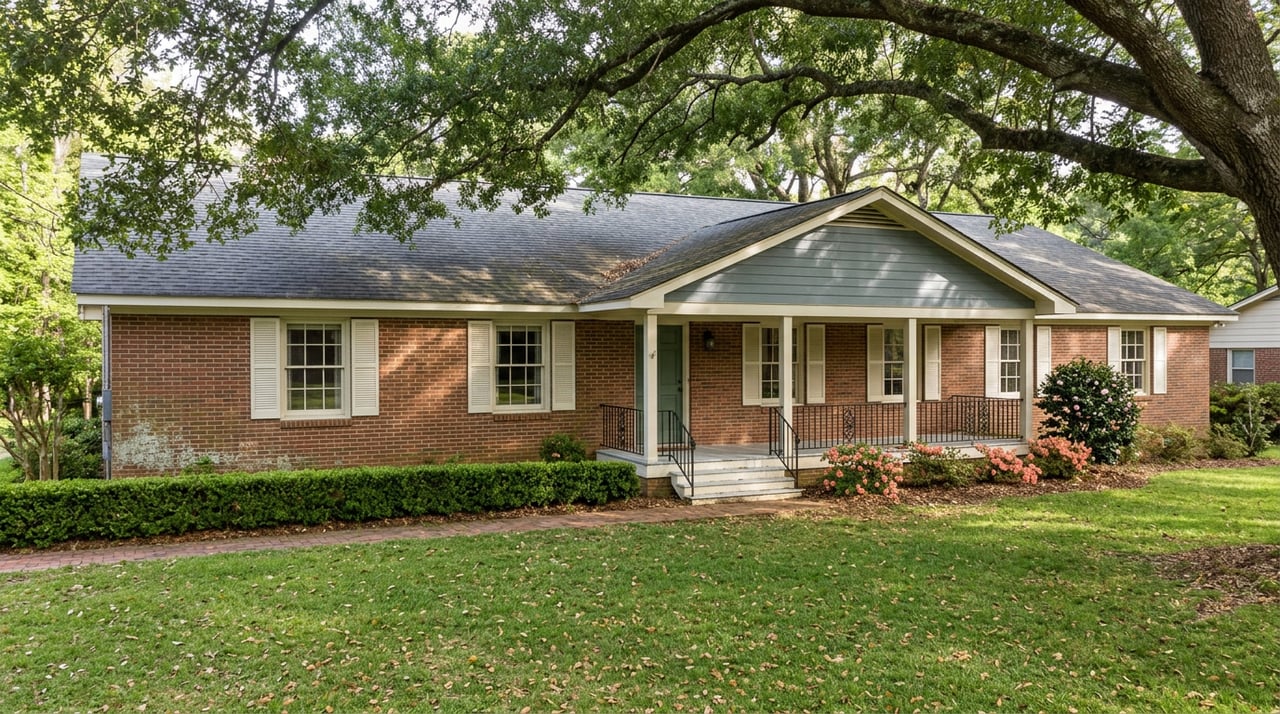
Put a single house into that picture and the confusion gets worse before it gets better. A three-bedroom resale near downtown and a new townhome off Ford Avenue can both be called a "Richmond Hill home" and land nowhere near the same number, yet all three reports will group them under one headline figure.
The Band That Actually Matters
The more useful number from all of this is not any single average. It is the spread. Resideline's tracking put the middle half of Richmond Hill closings between $383,940 and $555,900 over the six months ending in August 2026, a range of roughly $172,000 around a median of $446,895. That is a wide band for one city, and it tells you the median is doing less work than it looks like it's doing.
If your house or the one you are considering sits near the bottom of that range, the citywide median is not describing your market. It is describing new-construction subdivisions with pools and clubhouses that skew the average upward. If you are shopping under $384,000, expect a thinner set of comparable sales, not a broad menu, because that is where the older and smaller housing stock trades and there simply is not as much of it moving.
This is also where the Redfin and Zillow gap starts to make sense. If new construction is closing at a brisk pace and pulling the recent-activity average up, while the broader value index accounts for a larger pool of older homes moving more slowly, you would expect exactly this kind of split. The disagreement between the two is itself a signal about which part of the market is doing the moving.
The Real Tell Is on Ford Avenue
Price data can be argued about. Concrete cannot.
While the portals debate direction, the retail side of Richmond Hill has been making a much less ambiguous statement. Ford Avenue, the city's main commercial corridor and the road named for the same Henry Ford whose 85,000-acre winter retreat put this town on the map in the 1920s, broke ground last year on a $60 million mixed-use project called The Averly Richmond Hill. The development, built by ECI Group on roughly 30 acres less than a mile from I-95, is bringing 291 residential units, a mix of apartments and townhomes, alongside more than 3.5 acres of ground-lease retail pads that were slated for delivery in the first quarter of 2026.
The Averly is one part of a broader commercial picture. The Shoppes of Richmond Hill remains the corridor's anchor center, but multiple smaller Ford Avenue parcels have been actively marketed for retail and service use this year, from quick-service restaurant sites to office condos, each pitch leaning on the same argument: strong traffic counts, a growing residential base, and household incomes averaging near $99,000 in the immediate trade area.
The Hyundai Metaplant in nearby Ellabell, a $7.6 billion investment that celebrated its grand opening in March 2025 and is targeting more than 8,500 direct production jobs with a longer-term ceiling closer to 14,000 across the facility and its supplier network, is within commuting range of Richmond Hill. Fort Stewart, Gulfstream, and the Georgia Ports Authority are also part of the regional employment picture.
The portals will keep arguing about last month's percentage. The retail pads on Ford Avenue are the argument that the demand is real, because nobody breaks ground on 3.5 acres of ground-lease retail based on a rumor.
New subdivisions like Ogeechee Station, a 111-unit townhome community near Highway 17 and Highway 144, and established master-planned neighborhoods like Wexford and Waterways, round out the picture. This is a town building housing and commercial space at the same time, amid broader regional growth.
What This Means If You're Pricing a Listing This Fall
If you are getting ready to list a Richmond Hill home this fall, or you are comparing offers on one, three things follow from all of this.
- Do not anchor to a single portal's headline percentage. Ask what window it covers and whether it is measuring closings or an estimated index, because a 9.6 percent swing and a 1.8 percent drop can both be technically accurate descriptions of the same market.
- Find out where your specific property sits inside the actual closing range, not the citywide median. A home priced near $450,000 is sitting close to the middle of a genuinely wide band, while one near $380,000 is competing for a much thinner set of comparable sales.
- Watch the commercial side of the market, not just the residential side. Retail pad deliveries, new subdivision permits, and employer announcements tend to move slower and more deliberately than a monthly price index, which makes them a steadier read on whether demand is actually holding.
Fort Stewart, Gulfstream, and the Georgia Ports Authority gave Richmond Hill a durable employment base long before Hyundai arrived. What is different in 2026 is that the retail corridor is also seeing development. That is a more dependable story than any single month's percentage change, and it is the one worth paying attention to if you are trying to price a home correctly rather than just quote a number you found online.
Frequently Asked Questions
Why do Redfin and Zillow show opposite directions for the same market? They measure different things over different time frames. Redfin's figure reflects recent asking and closing activity and can move quickly with a strong month of new-construction sales. Zillow's home value index estimates value across the broader housing stock, including homes that have not sold recently, so it tends to lag and smooth out short-term swings.
Is the Hyundai Metaplant actually inside Richmond Hill? No. The plant itself is in Ellabell, elsewhere in Bryan County. Richmond Hill is the closest established residential and commercial community to it, which is why its housing and retail markets are absorbing so much of the ripple effect.
Does new retail on Ford Avenue mean prices will keep climbing? It means the underlying demand is being treated as durable enough for developers to commit real capital to it, which is a different question than whether next month's median ticks up or down. Price direction can still vary by price tier and by how much new inventory comes online at the same time.
If you are trying to figure out what your Richmond Hill home is actually worth in a market that cannot agree with itself, that is exactly the kind of conversation worth having before you set a number. Marjorie Wester has spent years reading Savannah-area closings tier by tier rather than headline by headline. Let's Connect.